A Waiting-Room Visit with One Thing to Notice
A waiting-room visit reveals how signs, seating and shared conventions organise arrival, helping you see what makes the next action clear.
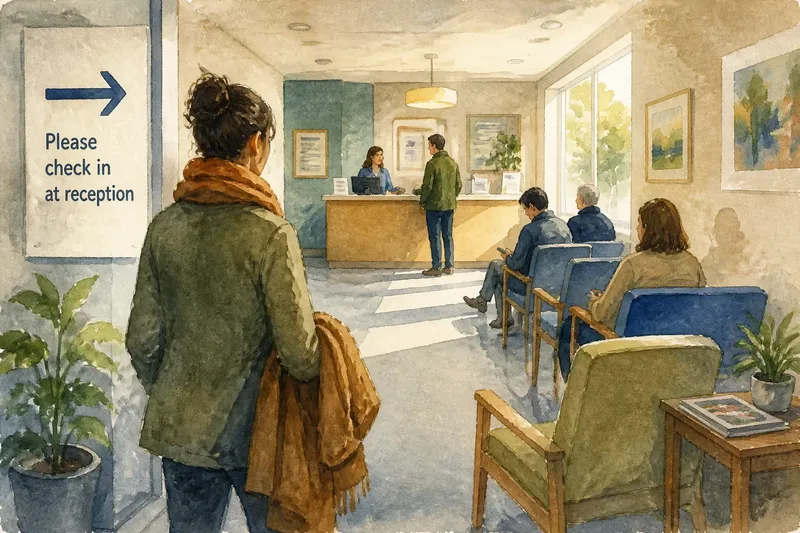
You arrive at a clinic with your coat over one arm and pause inside the waiting room. An arrow points towards reception; chairs face the corridor, and a narrow route leads to the desk. A waiting-room visit brings a shared convention into view: signs and layout help strangers coordinate small actions without constant conversation.
That convention is easy to overlook because it feels ordinary. Yet arrivals, check-ins, waiting and being called form a sequence that staff and visitors broadly recognise. Looking at how the sequence works can explain why a sign’s position or a clear path matters, without turning one room into a verdict on everyone’s experience.
Arrival conventions
Imagine a fictional community clinic where you have an appointment. A staff member asks you to check in at reception, then take a seat until your name is called. The entrance, sign and desk establish the order: arrive, check in, wait. This invented visit illustrates a familiar public convention, not a report about a real clinic.
A sign reading “Please check in at reception” is useful when it appears before visitors choose where to go. If it is visible from the doorway, it can make the next action clear. If it is hidden behind the chairs, someone may sit down first and then need to cross the room to check in.
The convention works through several cues at once. A sign gives directions, a desk provides a place to act on them, and staff can answer questions. None needs to carry the whole process alone. Together, they reduce the need for each new arrival to ask what happens next.
Seating and passage
In the invented room, most chairs face the corridor. One stands apart near a window. The arrangement offers choices, but also shapes movement: a row can leave a clear route, while a chair placed in the passage can make visitors weave around it.
That is one reason public waiting areas use conventions about taking a seat and leaving room to pass. People can wait without blocking the desk or doorway. The furniture makes those expectations easier or harder to follow, especially for someone carrying a bag, accompanying a child or using a walking aid.
Say you enter this fictional clinic and find the chair nearest the desk partly blocking the route. You check in, then sit in an open chair along the wall, leaving the passage clear. When a staff member later walks through without asking anyone to move, the observable result is a more direct route; the trade-off is that you sit farther from the desk. The example shows how a small choice can support a shared arrangement without implying anything about other visitors’ preferences.
Calls and responses
When a staff member calls a name, the usual convention is that the person who recognises it stands and follows. Others can remain seated, leaving the path open. The call acts as a shared cue: it marks a transition from waiting to the next part of the visit.
That cue may need support. A name can be hard to hear, or a visitor may not recognise the calling convention. A staff member repeating the name, making eye contact or giving a direct instruction can make the next action clearer. A clear route from chairs to doorway helps too.
Quiet behaviour can also be part of the shared arrangement. People often keep phone calls brief or speak softly in a waiting room, where conversations may be private. These are flexible conventions, not a demand that every visitor act in the same way.
What makes the sequence clear?
Where should reception signs appear?
A direction is easiest to use when a visitor can see it before choosing a route or seat. If the sign is obscured, a staff member or a second sign can provide another cue.
How can chairs leave a clear route?
Look at the path between the entrance, reception desk and doorway. If chair legs or bags narrow it, shifting furniture or asking staff for help may restore a more direct passage.
What happens when a name is called?
The usual sequence is for the person who recognises the name to stand and follow staff. If the call is unclear, repeating it or giving a direct prompt can help visitors know what to do.
Why do waiting rooms stay quiet?
Low voices can help people keep conversations private while sharing a small room. If someone needs assistance or has to speak more loudly to be heard, that practical need takes precedence over the convention.
Noticing shared rules
A single visit can show how a public convention is supported by ordinary design. Signs direct arrivals, chairs organise waiting, and a call signals when one person should move. The arrangement is not just a matter of individual manners; it is a small system shared by visitors and staff.
For a simple record, describe an observable sequence: “The reception arrow was visible from the doorway; the route to the desk stayed clear while I waited.” That note captures how the convention worked in that moment. If something obstructs your own route or leaves you unsure what to do, asking a staff member is more useful than trying to interpret the room alone.
A waiting-room visit is shaped by cues that connect one action to the next. Noticing where the sign appears, how the passage stays open and how staff call visitors offers a practical way to understand the convention: it helps people share a place and move through it with less confusion.