The Label That Makes a Jar Harder to Reuse
Jar label removal starts with identifying the material, helping you choose a gentle method and avoid needless scraping or damage to the jar’s finish.
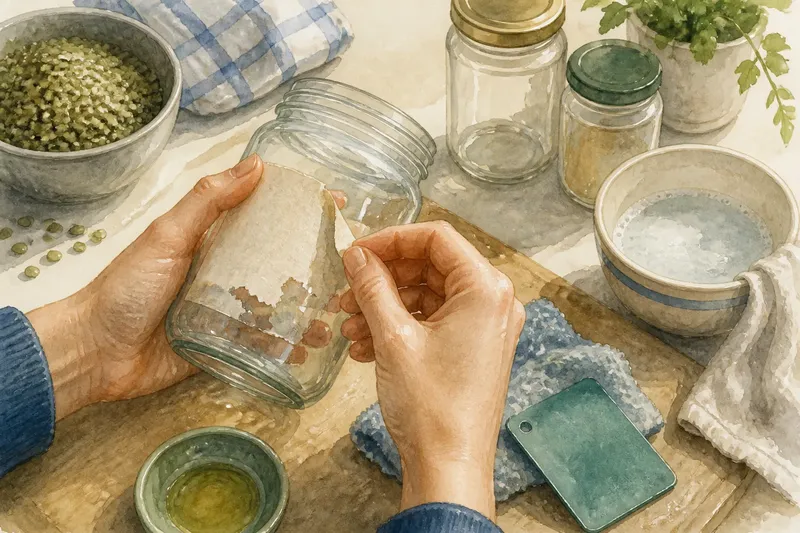
You have rinsed a pasta-sauce jar, but its label still clings to the glass, softened at one corner and stubborn everywhere else. Jar label removal is easier to approach when you first identify the label’s surface: paper, film, a sleeve or printing on the glass each calls for a different first attempt.
Read the surface
Look at a dry jar under ordinary light. Check an edge, seam or already-lifted corner. Paper often looks fibrous and matte. Plastic film is usually smoother and may stretch when gently lifted. A sleeve may have a seam or overlap. Printing directly on glass has no separate edge to peel.
These clues are not conclusive. Coated paper can resemble film, and adhesive may remain after a label comes away. You only need to choose a cautious first method, not identify the label’s exact composition.
Check the jar’s finish as well. If it has a printed pattern or a surface you want to preserve, do not treat it as bare glass. Keep the lid separate; its coating, seal or lining may not suit soaking.
Choose a gentle method
Plain paper: Try warm water with a little washing-up liquid. If an edge starts to release, peel slowly. If the paper tears, dampen it again instead of scraping harder.
Coated paper: Wet a small area with a warm, soapy cloth and see whether the paper separates from its coating. If it begins to lift, work gradually. If it shreds or stays firmly bonded, stop before you damage the jar’s finish.
Plastic film: Start with the jar dry. Lift a corner and pull slowly, keeping the film close to the glass. If it splits or will not release, pause and try a warm, damp cloth at the edge rather than reaching for a knife.
Shrink sleeve: Look for a seam or opening and work from there. Once the sleeve is off, inspect the glass; a separate adhesive label may be underneath.
No peelable edge: The design may be printed directly on the glass, or a label may be firmly bonded. Do not prise at it. If you need a plain jar, use another container rather than risk scratching or removing a finish you want to keep.
Remove sticky residue
After peeling, inspect the glass. A tacky patch is adhesive residue; a smooth, thin layer may instead be a coating left by the label. Begin with a clean cloth dampened with warm, soapy water. Let it rest on the patch, then rub gently. An old plastic loyalty card can help lift softened residue without the hard edge of a metal blade.
If water does not shift residue on plain glass, try a small amount of cooking oil on a cloth. Rub gently, then wash the glass thoroughly with washing-up liquid and rinse it well. Do not return the jar to food use while it feels oily or has residue on it.
Avoid combining cleaners or using a strong solvent without checking its directions and whether it suits the jar’s finish. If the surface or intended use is uncertain, leave the finish alone and choose another container.
When should you stop?
Why does the label tear into strips?
The label may be thin, coated or firmly bonded. Stop pulling and dampen a small section; if it still shreds, leave it rather than scraping harder.
What if glue remains after peeling?
Treat it as a separate residue problem. Try a warm, soapy cloth first, then a little cooking oil on plain glass if needed, followed by thorough washing.
Can I use a knife on the jar?
A knife can slip or scratch, so it is not a good first choice. Try a cloth or plastic card instead; if gentle methods fail, leave a finish you want to preserve alone.
What if the jar is decorated?
Keep water and rubbing away from decoration until you know how it behaves. If the label meets a finish you want to keep, use the jar for its original purpose or choose another container.
Match the next use
A jar for pencils or buttons may be useful with a faint mark. Food storage calls for a clean jar and lid, washed separately, and a container suitable for that purpose. The jar’s former contents do not establish that its lid or seal suits a new use.
Say you have a clean jam jar with a smooth label lifting at one corner, and you want to store dry lentils in it. You peel the film slowly; a tacky patch remains. You wipe that patch with a warm, soapy cloth, then wash, rinse and dry the jar. If the coating starts to lift with the label, you stop and use a different container for the lentils; the visible result is a clean jar without risking that finish.
For jar label removal, the useful decision is whether the label separates cleanly from a surface you are willing to treat. Start at an edge, separate peeling from adhesive cleanup, and stop when the finish is uncertain. A jar can still serve a purpose without becoming perfectly blank.