Why a Door Needs More Than a Handle
Why a door needs more than a handle: see how hinges, frame and latch work together, then choose the right opening style for the doorway.
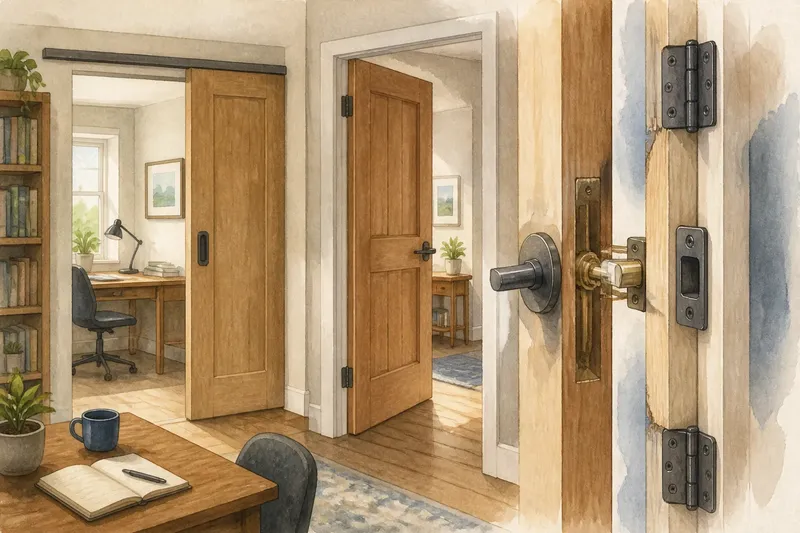
You turn a door handle, but the door does not move until its hinges let it swing and its latch clears the frame. Why a door needs more than a handle becomes obvious in that brief sequence: each part has a different job, and the right combination depends on the doorway and how people use it.
The opening sequence
A typical hinged door moves around a vertical line of hinges fixed between the door and its frame. The frame, also called the door lining or jamb, is secured in the wall and provides the fixed boundary the door closes against. Hinges carry the moving panel; they do not release the latch.
The handle operates a spindle, a short bar passing through the door. Turning the handle moves the latch mechanism inside the door edge. A spring latch retracts from the frame’s matching hole, known as the strike plate, so the door can swing. When you let go, the spring usually returns the latch to its resting position.
Closing reverses the sequence. The door swings towards the frame, the sloped latch meets the strike plate and slips back, then springs into the opening. The handle has helped release the latch, but the hinges, frame and latch have all had to align for the door to shut properly.
This is why a handle that turns freely may not open a door: the spindle or latch may not be moving as intended. A door that catches near its top or bottom points to a different part of the system. The visible symptom is useful, but it does not by itself identify the cause.
Three door approaches
For an ordinary interior doorway, the main choice is often between a hinged door, a sliding door and a hinged door fitted with a privacy or locking latch. Each uses a different opening arrangement, so the best fit depends on the space, the desired privacy and the type of access needed.
Hinged doors
A conventional hinged door suits a clear area where the panel can swing without hitting furniture or blocking a route. Its familiar handle-and-latch sequence is easy to understand, and the opening direction can be chosen to suit the room. The trade-off is the swing space: a door opening into a narrow hall can interrupt movement, while one opening into a small room can take up useful floor area.
Sliding doors
A sliding door travels along a track rather than swinging on hinges. It can suit a doorway where a swinging panel would obstruct furniture or a passage. The handle is usually a recessed pull, and the door may have a separate catch to hold it closed. The wall beside the opening must accommodate the moving panel, and a track or pocket arrangement needs to suit the doorway.
Privacy and lockable doors
A bedroom or bathroom door may use a latch with a privacy turn, while an external door may use a more substantial locking mechanism. These are not simply different handles: the handle or turn operates a particular latch or lock inside the door. Choose the arrangement for the access and privacy needed, rather than assuming that a familiar-looking handle provides the desired security.
Say you are choosing a door for a small study where a desk sits close to the opening. If the hinged panel would strike the chair, a sliding door may suit the available space; if the wall beside the doorway is occupied by shelves, a hinged door that swings out into a clear area may be the simpler fit. The observable check is whether the chosen panel can move through its full path without meeting the desk, shelves or people using the passage.
Which arrangement fits?
Think about the door’s movement before choosing its hardware. A quick check of the doorway and its surroundings can narrow the options:
- Room around the doorway: Note where a hinged panel would swing. If that path meets furniture or a busy route, consider a sliding arrangement or a different swing direction.
- Wall space beside the opening: Check whether a sliding panel has somewhere to travel. If shelves, switches or another doorway occupy that space, sliding may not be practical.
- Privacy needs: Decide whether the door needs a simple latch, an inside privacy turn or a lock suited to its location. Match the mechanism to the purpose.
- How the door is used: Consider whether people often carry objects through it or need to move between rooms without obstruction. A handle and opening direction that are easy to use matter more than decorative similarity alone.
- Existing frame and hardware: Look at the hinge positions, door edge and strike plate before replacing a handle. A new handle must operate a compatible latch, and a different door type may require changes beyond the handle itself.
For a replacement or alteration, the correct fitting depends on the door and hardware instructions, and local rules may apply to some locations. Check the relevant manufacturer guidance and local requirements; ask a qualified tradesperson where the fit or use is uncertain.
Common door questions?
Why does a handle turn but the door stay shut?
The handle may be turning without retracting the latch, or the latch may be held against the strike plate. Avoid forcing it, since that can damage the handle or door; if the cause is unclear, seek suitable repair help.
What does a door frame do?
The frame fixes the doorway’s boundary and provides the surfaces the hinges and strike plate attach to. If the door and frame are out of alignment, the latch may miss its opening or the panel may catch as it moves.
Can a handle make a door close by itself?
A handle does not normally control the door’s swing. A spring latch returns to its resting position, while a self-closing door relies on a separate closer or hinge mechanism.
Why does a sliding door have no ordinary handle?
Many sliding doors use a recessed pull so it does not protrude into the panel’s path. A separate catch may hold the door closed, so the pull and catch perform different jobs.
Follow the whole path
When a door feels awkward, watch its full movement rather than judging the handle alone. Notice whether the panel swings freely, whether its edge meets the frame evenly and whether the latch enters the strike plate. That sequence helps distinguish a problem with movement from one with release or alignment—and makes it clearer which kind of door and hardware suits the doorway.